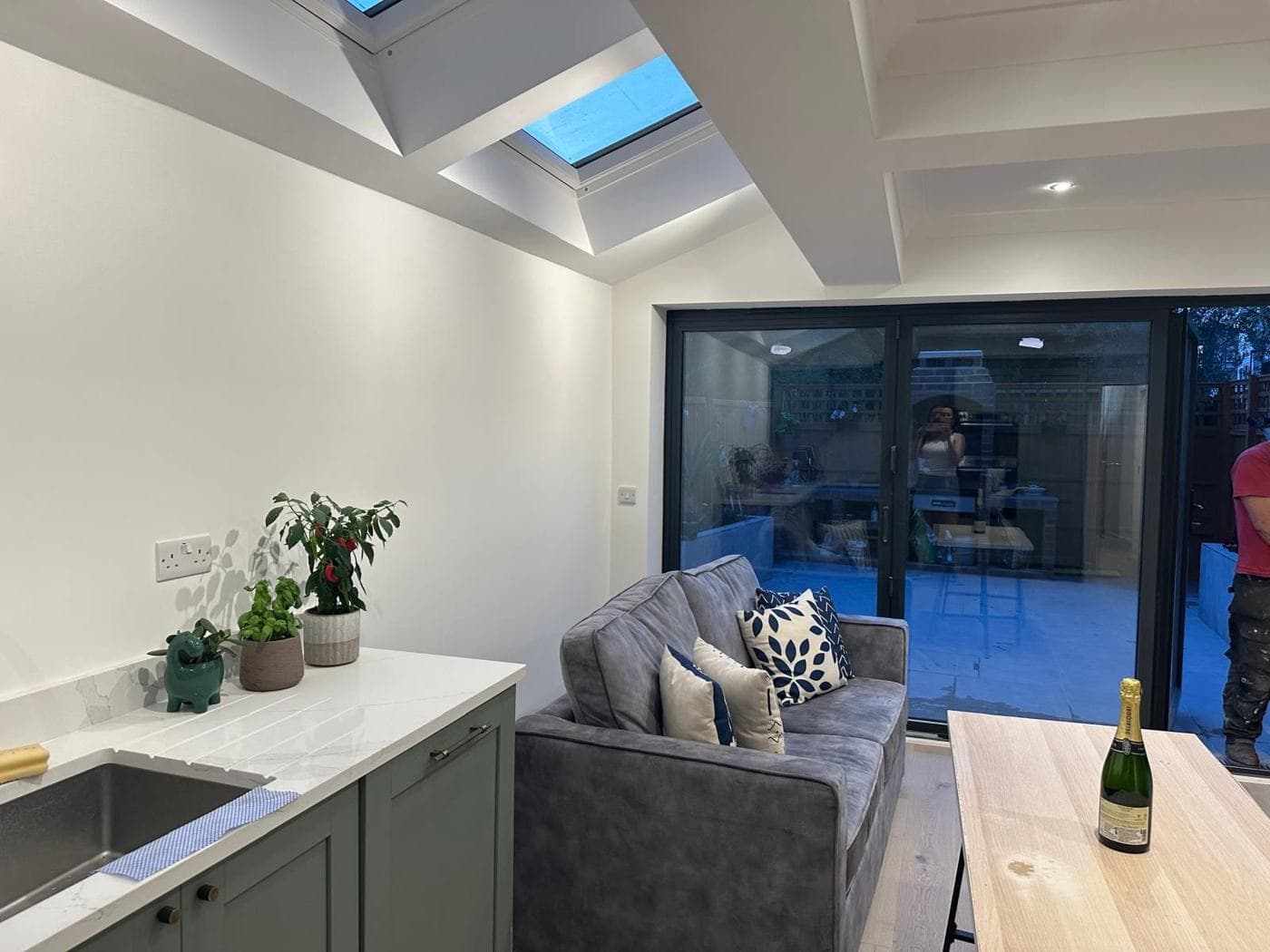
A kitchen extension is one of the most popular home improvements in London — and one of the most frequently misunderstood from a planning perspective. Many homeowners either assume planning permission is always needed, or assume it is never needed. The answer depends on your property and what you want to build.
The Starting Point: Permitted Development Rights
Under Permitted Development (PD) rights, homeowners in England can build certain extensions without submitting a planning application. These rights are set out in the Town and Country Planning (General Permitted Development) (England) Order 2015, as amended.
For a kitchen extension at the rear of a house, PD rights allow:
- Single-storey extension up to 4m deep on a detached house, or 3m deep on any other type (semi-detached, terrace)
- Under the Larger Home Extension scheme (prior approval route), extensions of up to 8m deep on detached houses and 6m deep on other houses are possible — subject to neighbour consultation
However, PD rights are subject to conditions that can remove them.
When Planning Permission Is Required
You will need full planning permission for a kitchen extension in any of these circumstances:
1. You live in a flat PD rights do not apply to flats or maisonettes at all. Any extension to a flat — regardless of size — requires full planning permission.
2. Your PD rights have been removed Article 4 Directions remove PD rights in specific areas. Many London boroughs have applied Article 4 Directions to large areas of terraced housing to protect the character of Victorian and Edwardian streetscapes. If your property is subject to an Article 4 Direction, even small rear extensions require full planning permission.
Common Article 4 areas in London include many parts of:
- Wandsworth, Lambeth, Southwark, Lewisham, Greenwich
- Parts of Hackney, Haringey, Islington, and Camden
Check with your local planning authority or use the Planning Portal's permitted development tool.
3. You have already used your PD allowance PD is assessed on the cumulative total of extensions added since 1948 (the baseline date). If a previous extension was built under PD, the remaining allowance may be limited.
4. Your property is listed Listed buildings require Listed Building Consent for any extension, regardless of size. Full planning permission is also required.
5. Your property is in a Conservation Area In Conservation Areas, additional restrictions apply. Some extensions that would be PD elsewhere require full planning permission.
6. Your extension exceeds PD size limits If you want a rear extension deeper than the PD limits, full planning permission is needed for anything beyond the PD threshold.
The Larger Home Extension Scheme
For extensions beyond the standard PD limits (up to 8m for detached, 6m for other houses), the Larger Home Extension scheme (technically Prior Approval — Larger Extension) allows larger extensions under a neighbour consultation procedure rather than full planning application.
Under this route:
- Your neighbours within a defined area are notified
- They have 21 days to object
- The council then determines whether the extension is acceptable in relation to its impact on neighbours
The assessment is limited to impact on neighbours — it cannot impose design conditions or refuse on aesthetic grounds. If no substantive objections are raised, prior approval is confirmed and the extension can proceed.
This route is more common than many homeowners realise and has enabled a significant number of large open-plan kitchen extensions in London since the scheme was extended permanently in 2019.
Lawful Development Certificate
Even if your extension falls within PD rights, it is strongly advisable to apply for a Lawful Development Certificate (LDC) before building. An LDC is a formal written confirmation from the council that your proposed development is lawful under PD rules.
Benefits of obtaining an LDC:
- Certainty before you invest in construction
- Evidence for your conveyancer when you sell
- Protection against enforcement action
- Resolves any doubt over PD eligibility
LDC applications cost around £206 in England (2026 fee schedule) and take approximately eight weeks. rcbGroup always recommends obtaining an LDC for PD projects where there is any ambiguity.
What About the Neighbour?
Under PD rights, you do not need your neighbour's permission to build an extension — but the Party Wall etc. Act 1996 may apply. If your extension:
- Involves excavation within 3m or 6m of a neighbouring foundation
- Involves work on or to a party wall (shared wall between semi-detached or terrace properties)
- Involves cutting into a party structure
...then party wall notices must be served before work begins.
Summary: Do You Need Planning Permission?
| Scenario | Planning Permission Needed? |
|---|---|
| Rear extension on a terrace, ≤3m deep, not in Article 4 area | No (PD) |
| Rear extension on a detached house, ≤4m deep, not in Article 4 area | No (PD) |
| Rear extension on a terrace in Article 4 area | Yes |
| Extension to a flat | Yes |
| Extension to a listed building | Yes (also Listed Building Consent) |
| Rear extension deeper than PD limits | Prior Approval or full planning |
| Side extension | Subject to strict PD rules — often requires planning |
| Double-storey rear extension | Yes |
rcbGroup
rcbGroup can advise on the planning status of your proposed kitchen extension, prepare Lawful Development Certificate applications, and manage the build from structural works through to kitchen installation. Contact us to discuss your project.