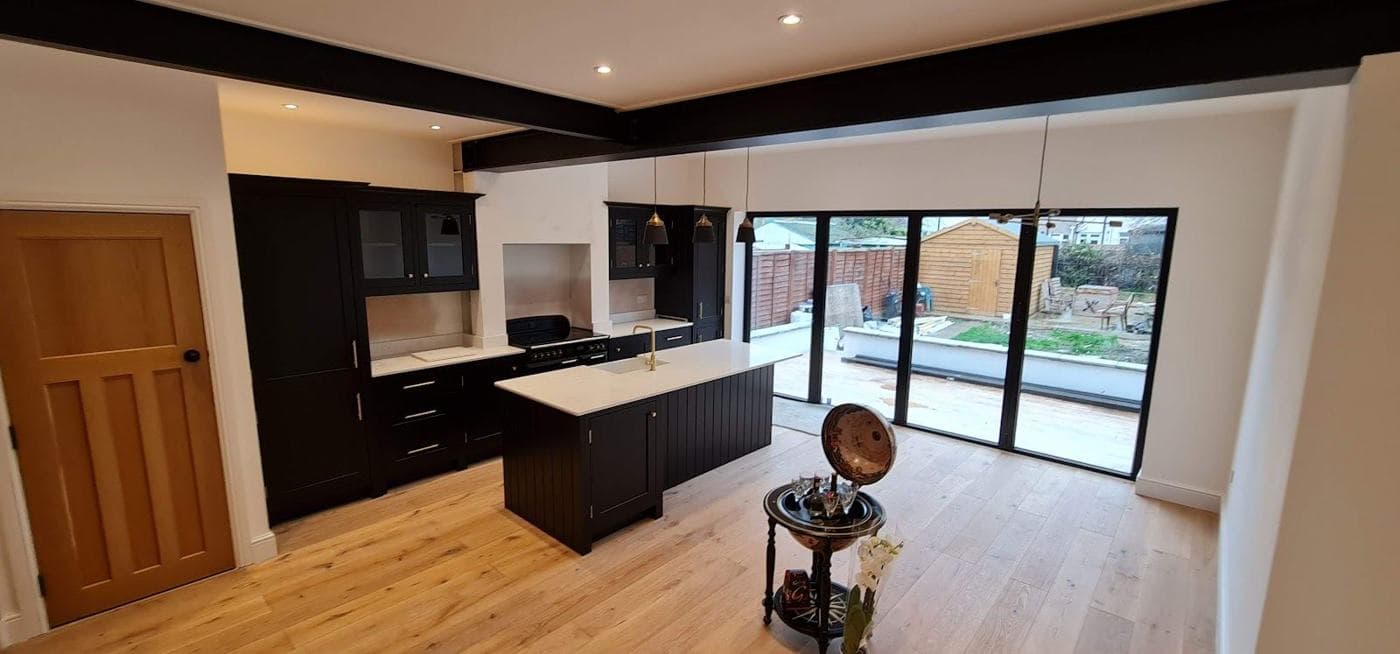
The choice of glazed doors across the rear of a kitchen-dining extension is one of the most visible design decisions in the project. For the last ten to fifteen years, aluminium bifold doors have dominated this market in London. More recently, sliding door systems — both conventional two-panel sliders and more sophisticated multi-panel stacking systems — have grown in popularity. Here is an objective comparison.
Bifold doors work by folding multiple panels back on each other. A four-panel or six-panel bifold creates a very wide clear opening across the full rear of the extension, with the stacked panels sitting to one or both sides of the opening when fully open. The visual impact when fully open is dramatic — the wall effectively disappears. Bifold doors are excellent for families who want a strong indoor-outdoor connection and who will regularly open the doors fully in good weather. The stacked panels when open do project into the room or onto the terrace by the depth of the stacked panels, which can be thirty to fifty centimetres. Bifold mechanisms are more complex than sliding systems and require more maintenance over time. Standard aluminium bifold doors in a four-panel configuration at 2.4 metres wide cost three thousand five hundred to seven thousand five hundred pounds supply only.
Sliding doors have panels that slide past each other in a track system. A standard two-panel slider opens approximately half of the total opening at once, which is less than a bifold. However, contemporary multi-panel stacking sliding systems can achieve a much larger clear opening — two, three, or four panels can stack behind one another to create an opening comparable to a bifold. The advantage of a sliding system is the thinner frame profiles that many premium sliding systems achieve, creating a more minimal appearance. Sliding doors also tend to have lower thresholds and can more easily achieve flush internal and external floor levels. Standard aluminium sliding doors in a two-panel configuration at 2.4 metres cost three thousand to seven thousand pounds supply only; premium multi-panel stacking systems cost eight thousand to twenty thousand pounds and above.
For most standard London kitchen-dining extension projects, bifold doors remain a strong default choice due to their familiarity, wide availability, and the genuine advantage of a very wide clear opening. Sliding systems are worth considering for clients who prioritise minimal frame aesthetics or who specifically want a flush floor threshold. At the premium end of the market, both systems produce excellent results and the choice comes down to personal design preference.
RCB works with both systems and will advise on what is most appropriate for the specific extension design and client requirement.