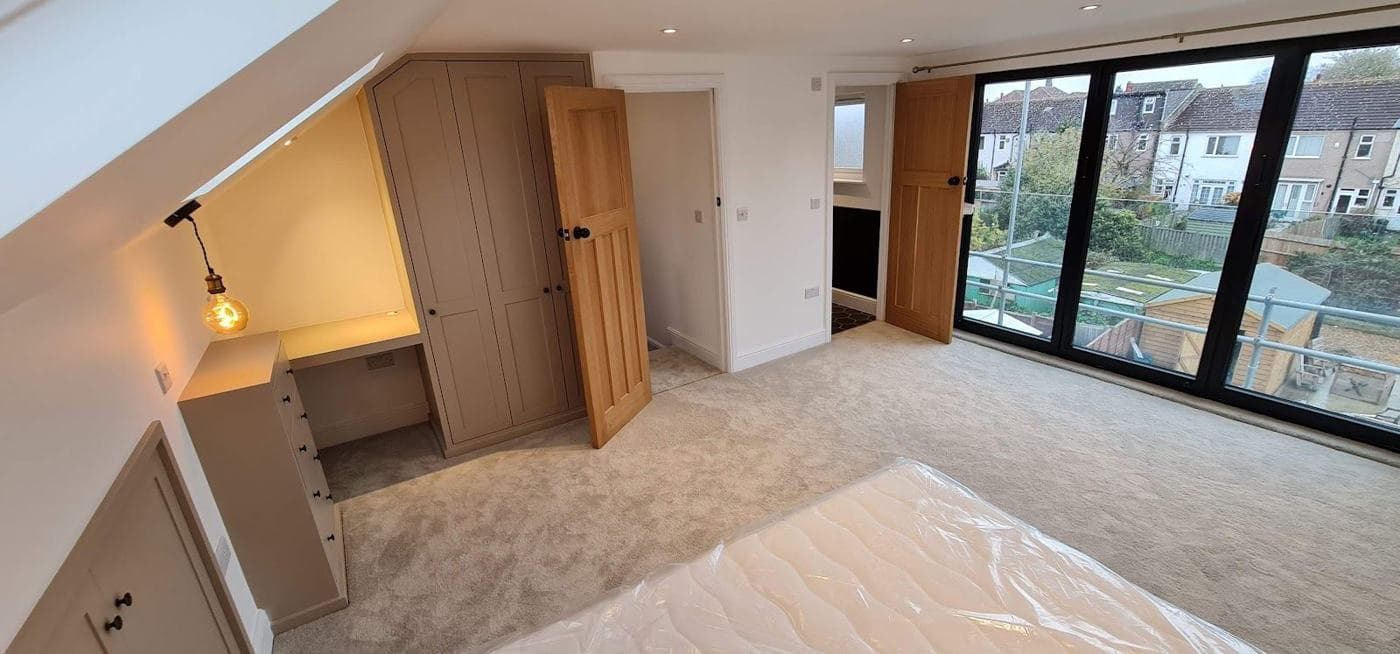
Does a loft conversion add value to a London property?
Does a loft conversion add value to a London property? The evidence in 2026
A loft conversion that creates an additional bedroom and bathroom is consistently one of the highest-return home improvement investments available in London. Unlike extensions, which require garden space and planning battles, loft conversions use space that already exists within the existing building envelope — and in London's high-density housing market, converting unused roof space into a habitable bedroom adds significant marketable value.
How much value does a loft conversion add in London?
The amount of value added depends on several factors, but research from estate agents, Rightmove, and Nationwide Building Society consistently indicates:
- Adding a bedroom to a 2-bed house to make it a 3-bed: value increase of approximately 15–25% in most London markets
- Adding a bedroom and bathroom to a 3-bed house to make it a 4-bed with en-suite: value increase of approximately 10–20%
- Adding a master bedroom suite with en-suite to a 4-bed house: value increase of approximately 8–15%
In absolute terms, in the London market as of 2026:
- Inner London (Hackney, Islington, Lambeth, Wandsworth, Lewisham, Greenwich): value uplift of £60,000–£150,000+ for a well-executed dormer loft conversion adding a bedroom with en-suite
- Outer London (Bexley, Bromley, Havering, Sutton, Hillingdon): value uplift of £35,000–£80,000 for a comparable conversion
- Zone 1-2 premium areas (Chelsea, Kensington, Hammersmith, Fulham): uplift of £150,000–£400,000 for a high-specification mansard or dormer
Why loft conversions generate strong ROI in London
Bedroom count drives buyer appetite: In London, property values are heavily influenced by bedroom count. The jump from 2 bedrooms to 3 bedrooms, or 3 to 4, is significant because it opens the property to a much larger pool of buyers — family buyers, who typically have more purchasing power than childless couples or single occupants.
The bathroom premium: A loft room with an en-suite bathroom generates significantly more value than a loft room without. Buyers in the London market are willing to pay a premium for a master suite with its own bathroom — it addresses the bottleneck created by a single family bathroom shared among multiple bedrooms.
Dense urban market: London's density means that space is genuinely scarce and the market rewards additional accommodation heavily. In many London suburban areas (Zones 3-5), a 4-bed house commands 20-35% more than a 3-bed comparable, while the cost of the loft conversion to create the 4th bedroom is typically £60,000–£90,000 — well below the value created.
Conversion vs. moving: Stamp Duty Land Tax in London on a property purchase in the £600,000–£1,000,000 range is £20,000–£43,750. Estate agent fees and moving costs add a further £20,000–£40,000. A loft conversion that adds equivalent value avoids these transaction costs entirely.
The calculation: illustrative London example
3-bed Victorian terrace in Lewisham, SE13:
- Existing value: £575,000 (3 bed, 1 bath)
- Rear dormer loft conversion cost: £75,000 (including bathroom, professional fees, VAT)
- Value after conversion (4 bed, 2 bath): £700,000–£730,000
- Value uplift: £125,000–£155,000
- Net gain (uplift minus cost): £50,000–£80,000
- Return on investment: 167–207% of the construction cost
3-bed Victorian terrace in Sutton, SM1:
- Existing value: £480,000 (3 bed, 1 bath)
- Rear dormer loft conversion cost: £72,000
- Value after conversion (4 bed, 2 bath): £550,000–£570,000
- Value uplift: £70,000–£90,000
- Net gain: £0–£18,000
- Return on investment: 97–125% of construction cost (lower ROI in more affordable outer London markets)
Factors that reduce the value added by a loft conversion
Poor design or execution: A loft conversion with low head height, an awkward staircase, inadequate light, or substandard workmanship will be discounted by buyers and their surveyors. London buyers are sophisticated — a poorly designed loft room will be perceived as a problem, not a benefit.
Lack of a bathroom: A loft bedroom without an en-suite adds less value than one with. In London's competitive market, buyers expect the additional bedroom to come with its own bathroom.
Loss of usable garden: Where the loft conversion was built over a side return, reducing the garden, the value calculation changes.
Conservation area or planning issues: A loft conversion without the correct planning consents or Building Control sign-off will be flagged during conveyancing and reduce the achievable sale price or even make the property unmortgageable.
Over-improvement for the area: In lower-value areas of outer London, a very high-specification loft conversion (mansard, full-height glazing, premium fit-out) may not generate proportionate value if the comparable properties in the street are more modest.
When not to do a loft conversion for value
- Where the property is a flat or maisonette and the freeholder will not grant consent
- Where the ceiling heights are insufficient (ridge below 2.2m) and the resulting room would be too low to attract buyers
- Where the planning position is genuinely restricted (listed building, conservation area with no precedent for dormers)
- Where the budget is insufficient to do the job properly — a cheap loft conversion with building defects, fire safety shortcuts, or non-compliance will reduce value rather than add it
Want advice on your own project?
Pick whatever suits you. We'll look at what you have (drawings, photos or quotes) and tell you honestly what the next step should be.
Prefer to phone? Call +44 7359 872594.
Important Note
This guide is for general information only. Building regulations, planning rules, and legal requirements change regularly and vary by local authority. Always seek professional advice specific to your project and location. To talk through your own project, book a project review.
Was this guide helpful? Share it:
Have a question about your project?
Message us on WhatsApp or call — we reply during working hours (Mon–Fri 8am–6pm, Sat 9am–2pm).