Contents
Snagging in London Home Construction
Snagging is the process of identifying and recording incomplete or defective items in a building project before or immediately after practical completion. A snagging list is the document that records these items, and the contractor is typically obliged to rectify them within a defined period following practical completion.
For London homeowners, snagging is an important final quality assurance step and one that should not be rushed. Incomplete snagging at handover can result in items that should have been addressed by the contractor under the original contract being treated as variations or even being left unresolved.
What Is Practical Completion?
Practical completion is a formal milestone in a construction contract. It is reached when the works are substantially complete to the point where the building can be used for its intended purpose, even if minor outstanding items remain. Practical completion is not the same as full completion.
At practical completion, typically:
- The client takes possession of the property
- The contractor's obligation to insure the works transfers to the client
- The defects liability period begins (typically 6 or 12 months, depending on the contract)
- Any retention held by the client is partially released
After practical completion, the contractor retains an obligation to return and rectify defects that emerge during the defects liability period. At the end of the defects liability period, a final inspection is carried out, and if no outstanding defects remain, the final retention is released.
How a Snagging Inspection Is Conducted
A snagging inspection is carried out room by room, systematically checking all finished surfaces, junctions, installations, and fittings against the specification and expected quality standard. A thorough snagging inspection for a London extension or loft conversion typically takes 2--4 hours; a full house refurbishment may take a full day.
Items inspected typically include:
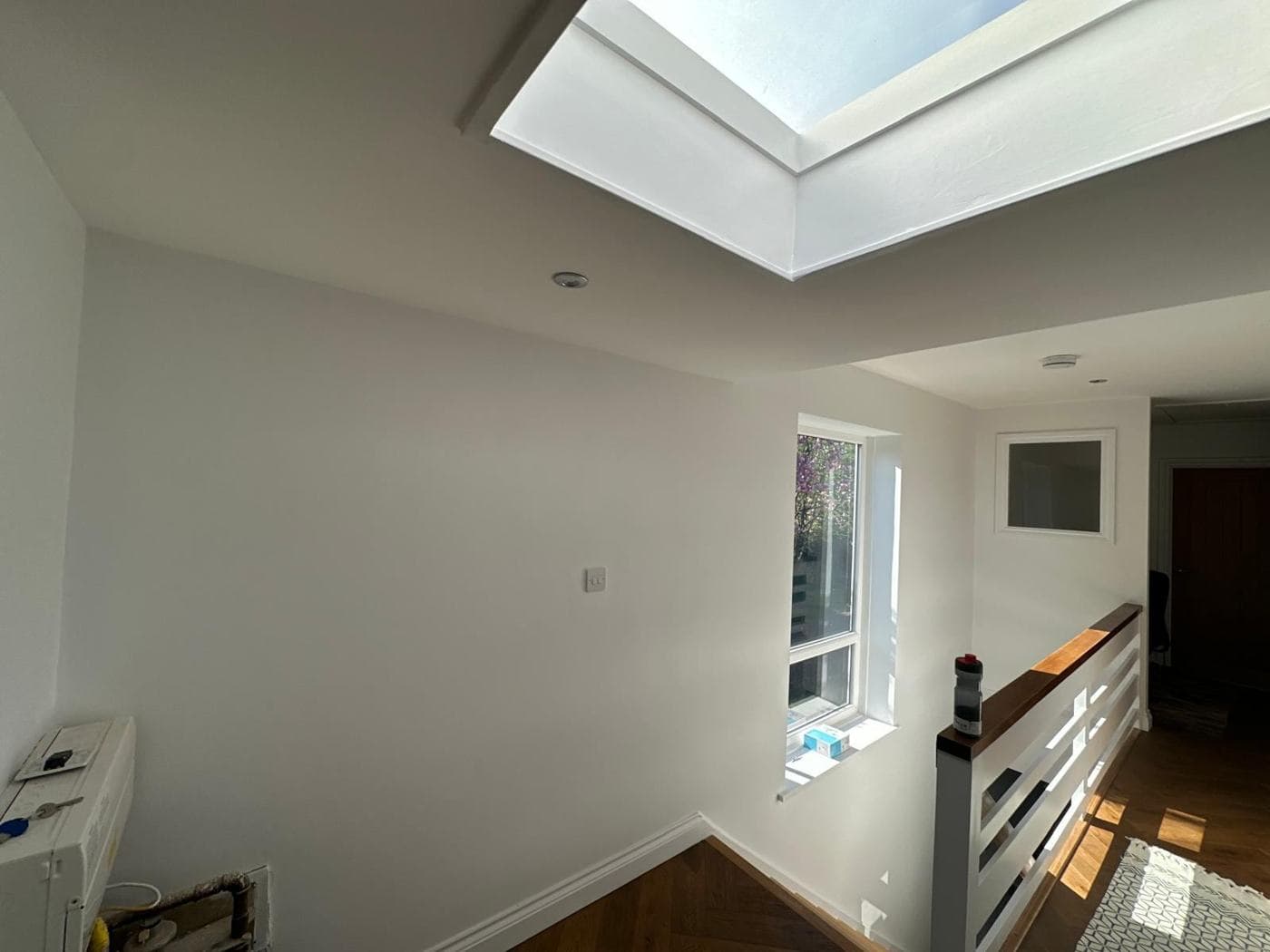
- Painted surfaces (roller texture uniformity, drips, misses at reveals, cutting-in quality at junctions with woodwork and ceilings)
- Plastered surfaces (hollowness, cracks at junctions, arris quality, finish uniformity)
- Joinery (door fitting and operation, gap uniformity, handle alignment, architrave and skirting mitres and fixings)
- Tiling (grout uniformity, alignment, chip-free, cuts clean at junctions, sealant bead continuity)
- Sanitary ware and bathroom fittings (sealant quality, cistern operation, drainage rates, hot water temperature)
- Electrical (switch and socket alignment, cover plate fit, light fitting alignment, all circuits operational)
- Windows and external doors (operation, locks, seals, drainage, ironmongery)
- Roof and external (gutter fall and fixings, flashing continuity, pointing, rendering finish)
- Structural elements where visible (beam soffit paint, visible padstone finish, floor level uniformity)
Who Carries Out the Snagging Inspection?
In a straightforward residential project, the snagging inspection is carried out by the client, often accompanied by the contractor. The client walks the property, the contractor notes the items, and a snagging list is agreed.
For larger projects, or where the client does not feel confident assessing building quality, an independent snagging inspector (typically a surveyor or building consultant) can be appointed to carry out the inspection on the client's behalf. Independent snagging inspectors are particularly useful where:
- The project is a new-build or large refurbishment
- The client suspects that quality standards may not have been met
- The contract includes a significant retention to be released at practical completion
- The client has limited construction knowledge and is uncertain what to look for
Independent snagging inspector costs: typically £300--£600 for a London residential project, depending on the size of the property. This is often good value relative to the cost of items left off the snagging list.
What the Contractor Is Obliged to Rectify
Under a building contract, the contractor is obliged to make good:
- Items that do not conform to the specification
- Defective workmanship
- Incomplete works that were included in the contract scope
The contractor is generally NOT obliged to rectify:
- Items that represent a reasonable standard of workmanship but that the client simply does not like (a taste preference is not a defect)
- Items caused by the client's own acts or omissions
- Items outside the original contract scope (these should be treated as variations if the client wants them done)
- Normal settlement or movement in new structures (within tolerance)
A well-prepared specification and a clearly agreed scope of works reduces the ambiguity around what the contractor is and is not responsible for at snagging.
Defects Liability Period
The defects liability period (DLP) is the period after practical completion during which the contractor is obliged to return and remedy defects that emerge. Under JCT Minor Works contracts (commonly used for London residential projects), the DLP is typically 3 or 6 months. Under JCT Homeowner contracts, the DLP may be 6 or 12 months.
Defects that emerge after the DLP ends are not generally the contractor's responsibility under the contract -- though statutory rights and the Consumer Rights Act 2015 may apply for a longer period for residential consumers.
rcbGroup and Snagging
rcbGroup carries out a pre-handover internal snagging inspection before inviting clients to the formal handover inspection. We prefer to identify and resolve items ourselves before the client walks the property, rather than presenting a list of known issues for the client to discover. Our post-completion defects liability process is managed by Faith, who coordinates return visits for any items identified after handover.
Contact our team to discuss quality standards and the handover process for your London project.
Want advice on your own project?
Pick whatever suits you. We'll look at what you have (drawings, photos or quotes) and tell you honestly what the next step should be.
Prefer to phone? Call +44 7359 872594.
Important Note
This guide is for general information only. Building regulations, planning rules, and legal requirements change regularly and vary by local authority. Always seek professional advice specific to your project and location. To talk through your own project, book a project review.
Was this guide helpful? Share it:
Have a question about your project?
Message us on WhatsApp or call — we reply during working hours (Mon–Fri 8am–6pm, Sat 9am–2pm).