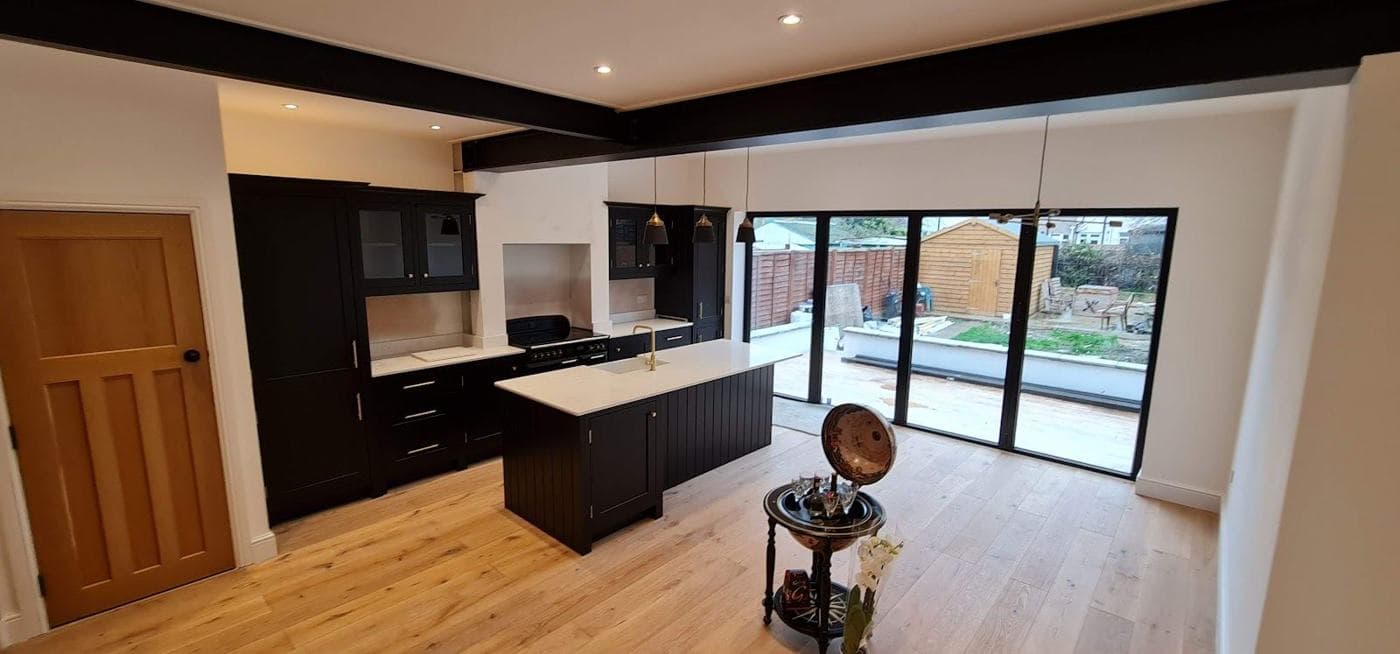
"What does an extension cost per square metre?" is the most common question rcbGroup receives from homeowners at the earliest stage of planning. Cost per square metre is a useful reference point — but it is also one of the most misunderstood metrics in residential construction. This guide explains what it includes, what it excludes, and what the actual numbers look like in London in 2026.
What Cost Per Square Metre Typically Includes
When a contractor or industry guide quotes a cost-per-square-metre range for an extension, it generally covers:
- Substructure: Foundations — strip, pad, or raft depending on ground conditions
- Superstructure: External walls, structural frame, columns or steelwork
- Roof structure and covering: Flat or pitched, including insulation and waterproofing
- Internal walls: Stud partitions
- First fix carpentry: Structural timber, roof joists
- Electrics (first fix): Cable runs, consumer unit circuit, back boxes
- Plumbing (first fix): Pipe runs, soil stack if applicable
- Insulation: Floor, wall, and roof insulation
- Plasterboard and plaster: Internal surfaces
- Windows and external doors: Standard specification
What it does NOT include (and this is critical):
- Kitchen or bathroom fit-out: If the extension includes these rooms, add significant cost
- Second-fix materials: Client-supplied in rcbGroup's standard scope — tiles, flooring, sanitaryware, light fittings, sockets
- Structural engineer fees: Separate professional cost
- Architect or designer fees: Separate professional cost
- Planning application fees: Council fees
- Building Control fees: Council or AI fees
- VAT (domestic building work is usually zero-rated for new builds, standard-rated for extensions — but check for your specific project)
- Landscaping or external works
- Party wall surveyor fees (if applicable)
- Contingency
London Extension Cost Per Square Metre Ranges (2026)
| Extension Type | Low (basic spec) | Mid (good spec) | High (premium) |
|---|---|---|---|
| Single-storey rear (masonry) | £2,000/m² | £2,800/m² | £3,800/m² |
| Single-storey rear (timber frame/SIPs) | £1,900/m² | £2,600/m² | £3,500/m² |
| Double-storey rear (masonry) | £1,800/m² | £2,500/m² | £3,400/m² |
| Wrap-around (single-storey) | £2,100/m² | £3,000/m² | £4,000/m² |
| Orangery/structural glazing | £3,000/m² | £4,500/m² | £6,000/m²+ |
These figures are for London, Q3 2026. They exclude second-fix materials, professional fees, and external works.
Why the Same Extension Has Wildly Different Quotes
Homeowners frequently receive quotes ranging from £100,000 to £180,000 for the same extension and wonder why. Common reasons:
1. Scope differences: One quote includes landscaping, kitchen, and all materials. Another covers structural work only.
2. Material specification: Client-supplied versus contractor-supplied materials make a huge cost difference.
3. Contractor overhead: A principal contractor managing multiple trades and carrying full insurance, warranties, and contract liability costs more than a loose collection of sole traders.
4. Contingency: Responsible contractors include contingency (typically 5–15%) for unforeseen conditions. Others exclude it and charge extras later.
5. Foundation assumptions: If no ground investigation has been done, some contractors assume simple strip foundations. Actual ground conditions (poor bearing capacity, proximity to trees, London clay shrinkage) can change foundation costs significantly.
6. VAT: Some sole traders are not VAT registered. Their net cost may look lower, but any project where the contractor is VAT-registered will add 20% to materials and some labour.
The Problem with Small Extensions
Cost per square metre is most useful for larger extensions (30m² and above). Small extensions (under 15m²) have proportionally higher cost per square metre because the fixed costs — scaffolding, foundation mobilisation, utility diversion, connection to the existing structure — do not reduce proportionally with size.
A 6m² kitchen extension may cost £3,500/m² while a 40m² kitchen/dining extension for the same house costs £2,400/m² — not because quality is lower, but because the fixed costs are spread across more area.
What Determines Where Your Project Sits in the Range
| Factor | Pushes cost DOWN | Pushes cost UP |
|---|---|---|
| Access | Clear rear access | Tight terrace, no side access |
| Ground conditions | Good bearing, no trees | London clay, nearby trees, poor drainage |
| Roof type | Flat (cheaper) | Pitched, hip-to-hip, or complex roof |
| Facade | Render or simple cladding | Matching London stock brick |
| Integration complexity | Simple structural opening | Multiple openings, rerouted services |
| Finish specification | Standard | Premium |
Getting a Reliable Estimate
Cost per square metre is useful for a first sanity check, but a reliable estimate for your project requires:
- Architectural drawings (even sketch/planning level)
- A site visit to assess ground conditions, access, and existing structure
- Clear scope: what is included, what the client supplies, what the contractor supplies
- Structural engineer input on foundations and openings
rcbGroup provides professional pre-construction estimates based on drawings and site visits rather than per-square-metre rules of thumb. This protects both the project and the client from surprises.
rcbGroup
Contact rcbGroup for a site visit and professional estimate for your London extension. We break down costs clearly, explain what is included and excluded, and give you a reliable basis for decision-making.